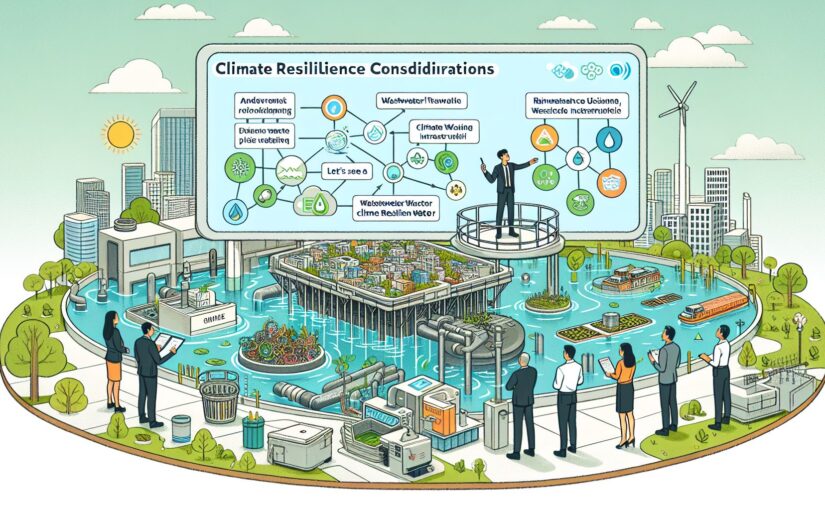
Climate resilience is a critical notion that needs to be incorporated into wastewater policy planning, primarily due to global climate uncertainties and changing environmental conditions. This involves developing strategies to improve infrastructure durability and ensure continual service availability under variable climate conditions.
Climate Resilience and Wastewater Management
Climate resilience refers to the ability of systems, entities, or communities to resist and recover from climate-associated disturbances. In the context of wastewater management, incorporating resilience emphasizes the need to adapt to climate change effects, including droughts, floods, and sea level rise, potentially impacting the infrastructure’s functionality.
Wastewater infrastructure includes all systems involved in water transfer, processing, and discharge, and their resilience can be significantly improved by implementing conscious planning and management practices. The infrastructure resilience guidance provided by the Federal Emergency Management Agency (FEMA) provides directed approaches to address these concerns at a systemic level.
Climate Change Impacts on Wastewater Systems
Climate change has significant implications for wastewater systems, including altering precipitation patterns and exacerbating extreme weather events. Higher rainfall may lead to overflow issues in wastewater facilities, while droughts might limit water availability required for wastewater processing.
Moreover, climate change may exacerbate the occurrence and intensity of floods, posing a severe threat to infrastructure located in flood-prone zones. Rising sea levels may lead to saltwater intrusion into freshwater sources, increasing the salinity of wastewater and potentially affecting treatment processes.
Incorporating Climate Resilience into Wastewater Policy Planning
A proactive approach for wastewater policy planning involves conducting vulnerability assessments and implementing mitigation measures. These steps encompass evaluating the system’s extant resilience and identifying aspects vulnerable to climate-related disturbances.
Vulnerability Assessments
Vulnerability assessments gauge the extent to which a system is susceptible to climate change effects. They relate primarily to system elements that may be subject to climate variability like potential precipitation changes, temperature fluctuations, or sea level rises. These could be physical assets like pipes and treatment plants or functional components such as wastewater treatment processes.
On a larger scale, vulnerability assessments should consider regional or catchment-level issues like flood risks and water availability trends. The Integrated Assessment of Water Resources and Global Change, a project by The Earth Institute, Columbia University, discusses relevant vulnerability assessment methods.
Mitigation Measures
After identifying vulnerabilities, the next step towards climate-resilient wastewater management includes devising and implementing mitigation measures.
Building new infrastructure or modifying existing facilities to better withstand climate-related stressors is crucial. This might involve incorporating flood-resistant design parameters, enhancing plant processing capacity, or exploring decentralized systems for improved service continuity.
Additionally, improving operation and maintenance practices can boost community resilience by ensuring efficient system operations under a range of climatic conditions.
Communication and Capacity Building
To promote climate resilience in wastewater policy planning, it is crucial to communicate these concepts clearly within and outside the wastewater management community. Training programs for municipal workers, emergency coordination forums for various stakeholders, and public awareness campaigns can foster a broader understanding of the importance of climate resilience.
The United States Environmental Protection Agency (EPA)’s Operator Outreach Program provides resources to help utilities deliver critical training and outreach initiatives.
Conclusions
A comprehensive approach to climate resilience in wastewater policy planning necessitates the integration of vulnerability assessments, the implementation of mitigation measures, and community capacity building. Incorporating climate resilience considerations helps ensure the sustainability and functionality of wastewater systems despite unpredictable and potentially disruptive climatic conditions.

In an era of mounting environmental uncertainties, the call for climate-resilient wastewater policy planning is more critical than ever. Discerning the operational challenges and incorporating strategic responses in policy framework will enhance public health and environmental protection endeavors.